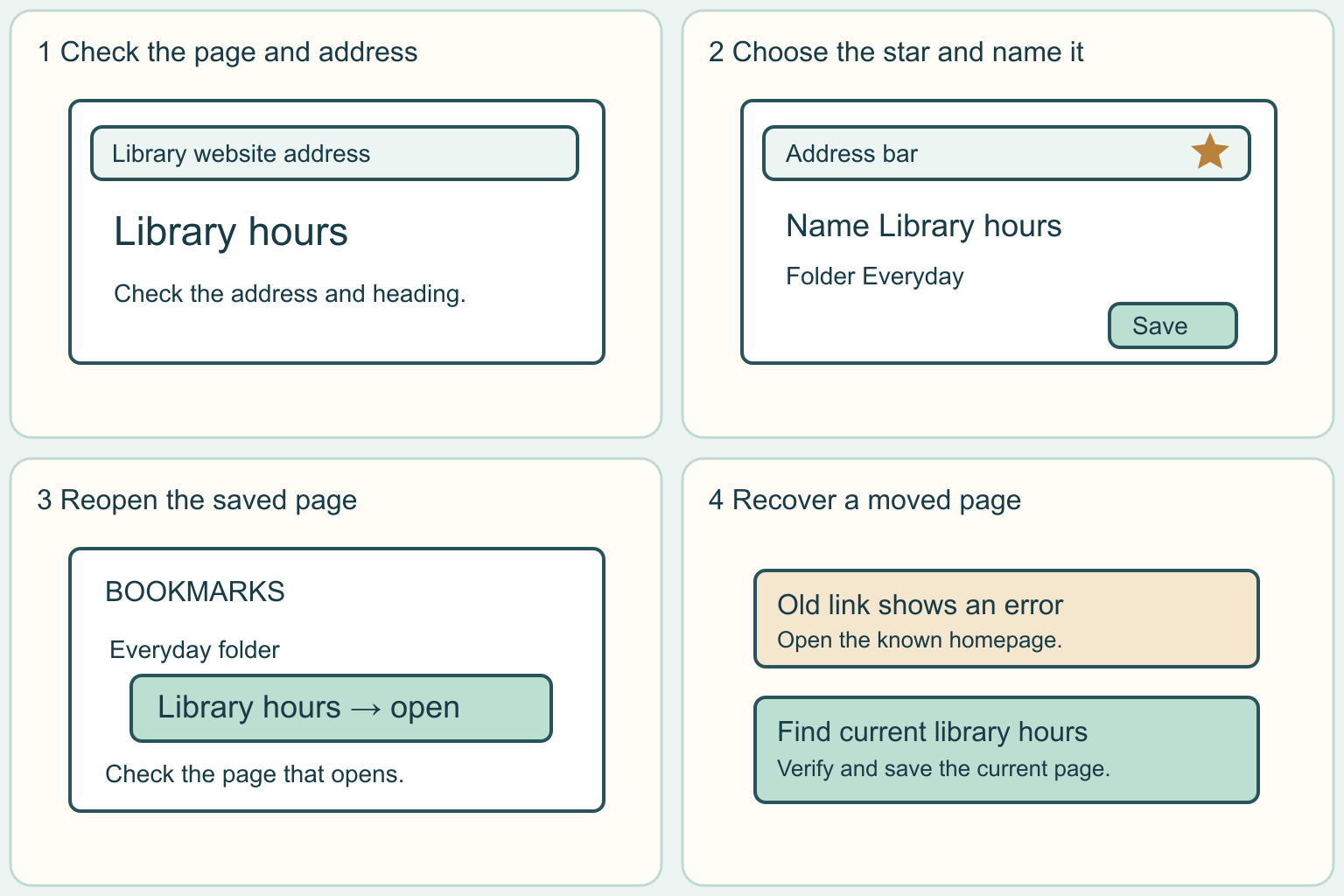
Save one useful page, give it a name and practice finding it again.
Why it matters: A bookmark helps you get back to a page without searching for it every time.
Written guidance reviewed: 2026-11-08 · Sources and equipment assumptions are below.
Take this guide to another device
Steps, notes, supplies, setup choices, results and check dates save on this browser as you work. Plus can also keep an account copy. Account copies update only when you choose Save; loading one replaces the browser draft shown here.
Review all saved work. Saved account check dates appear in My Day. Clear the date and save again to finish a follow-up. Email settings stay separate; existing opted-in agenda or deadline emails can include these dated actions.
Understand the job before starting
A bookmark helps you get back to a page without searching for it every time.
A common mistake to avoid
Menu names may vary with the browser and device. If the star opens an edit window, the page may already be saved. Check its name and folder before making another bookmark.
Words used in this guide
Rent
The amount paid to use someone else’s property for an agreed time. Read the example
Use what you already have. Check each item when it is ready.
Before you begin
Practice on your own browser profile. Keep private account links, sign-in codes and passwords out of shared worksheets. If a saved link opens an unexpected sign-in page, use the organization’s known homepage.
0 of 4 steps checked0%
Guide progress and notes save on this browser; choose Save account copy above to carry them to another device with Plus. Downloads contain the complete blank checklist; print to include your current checks and notes.
Do it with me
Your step position saves on this browser. Use the picture when available, then check the written result.
STEP 1 OF 4
Open the page you want to keep
Start here: Use a known website to reach the page.
Illustration: Open the page you want to keep. Read the steps for your exact task.
Read-aloud is available in supported browsers; the written steps always remain available.
A bookmark is a saved link you can use to reopen a page.
The address bar is the field near the top of your browser that shows where you are.
For practice, open a public page you already trust, such as your library’s hours.
Read the page heading and check the website address against a source you know.
If the page asks for a password unexpectedly, stop and use your usual route to the organization.
Before moving to the next step
Check this specific result: I checked the website address and opened the page I want.
If that result is not true yet, leave the box unchecked. Write what is missing in your notes; use the official instructions below when the equipment or situation differs.
STEP 1 OF 4
Open the page you want to keep
Start here: Use a known website to reach the page.
Illustration: Open the page you want to keep. Read the steps for your exact task.
A bookmark is a saved link you can use to reopen a page.
The address bar is the field near the top of your browser that shows where you are.
For practice, open a public page you already trust, such as your library’s hours.
Read the page heading and check the website address against a source you know.
If the page asks for a password unexpectedly, stop and use your usual route to the organization.
Before moving to the next step
Check this specific result: I checked the website address and opened the page I want.
If that result is not true yet, leave the box unchecked. Write what is missing in your notes; use the official instructions below when the equipment or situation differs.
STEP 2 OF 4
Save the link with a clear name
Start here: Choose the star beside the address bar.
Illustration: Save the link with a clear name. Read the steps for your exact task.
On a computer in Chrome or Firefox, look for the star near the address bar.
Select it to bookmark the current page.
If a small window opens, give the link a name that will make sense later, such as Library hours.
A folder groups related links.
Pick a folder you can find again or note where the browser puts the link.
Finish with the button shown, such as Done or Save.
Before moving to the next step
Check this specific result: I saved the link and know the name and folder to look for.
If that result is not true yet, leave the box unchecked. Write what is missing in your notes; use the official instructions below when the equipment or situation differs.
STEP 3 OF 4
Find the bookmark again
Start here: Open the browser’s bookmarks list and look for your saved name.
Illustration: Find the bookmark again. Read the steps for your exact task.
Open a new tab to test your link.
In Chrome, open the browser menu and look under Bookmarks and lists for Bookmark Manager.
In Firefox, open the browser menu and find Manage bookmarks under Bookmarks.
Look in the folder you picked or search for your bookmark name.
Select the saved link and check that it opens the intended page.
Keep your original tab open if you still need it.
Before moving to the next step
Check this specific result: I reopened the intended page from the saved bookmark.
If that result is not true yet, leave the box unchecked. Write what is missing in your notes; use the official instructions below when the equipment or situation differs.
STEP 4 OF 4
Check the link when it changes
Start here: Use the organization’s site to find the current page.
Illustration: Check the link when it changes. Read the steps for your exact task.
A bookmark remembers an address.
The organization may move the page or change what it shows.
If your link opens an error or unfamiliar page, go through the organization’s known homepage and find the current page there.
Verify it, then save that address with a clear name.
You can edit bookmark names through the browser’s bookmarks list.
If the bookmark seems missing, first check that you are using the same browser and profile, the browser’s separate space for your settings and links.
Before moving to the next step
Check this specific result: I know where to look for my bookmark and how to recover a moved page.
If that result is not true yet, leave the box unchecked. Write what is missing in your notes; use the official instructions below when the equipment or situation differs.
Pictures for this guide
Picture 1 of 4 · Open the page you want to keep
A browser window shows the address bar and the Library hours heading.
For: Open the page you want to keep
Illustrations show examples of the actions above. Follow your equipment’s instructions.
Notes about these pictures
A bookmark is a saved link you can use to reopen a page. The address bar is the field near the top of your browser that shows where you are. For practice, open a public page you already trust, such as your library’s hours. Read the page heading and check the website address against a source you know. If the page asks for a password unexpectedly, stop and use your usual route to the organization.
Practice on your own browser profile. Keep private account links, sign-in codes and passwords out of shared worksheets. If a saved link opens an unexpected sign-in page, use the organization’s known homepage.
Was this step clear?
Flag “Open the page you want to keep” for review. We save the guide and step identifiers with your account to limit duplicates, not your private notes.
A specific companion has not been selected for this new guide yet. You can search for related demonstrations; search results have not been reviewed by Life’s Checklists.
These YouTube videos belong to their respective creators. Life’s Checklists does not own them and is not affiliated with the creators. Links open on YouTube, where the videos are available independently of our membership.
How to use the video with this guide
Read “Before you begin” first. Watch the relevant part, pause, then return to the written step and its completion check. Use captions and playback speed if they help. A demonstration may cover only part of the task or show different equipment.
Your model’s instructions and current official guidance take priority. For urgent problems, follow the stop instructions without waiting to watch a video.
Finish the job and know what to do next.
For this guide, the final result is: I know where to look for my bookmark and how to recover a moved page.
A concrete way to approach this task
In this fictional example, Nia opens the public library hours page. She saves it as Library hours, then finds the saved name in the bookmarks list and opens it from a new tab.
What if I cannot complete a step?
Menu names may vary with the browser and device. If the star opens an edit window, the page may already be saved. Check its name and folder before making another bookmark.
Identify the exact step: “Open the page you want to keep.” Record what you tried, what happened, and which item or model you used. Ask for help with that specific problem rather than repeating an unsafe or unsuccessful action.
Practice on your own browser profile. Keep private account links, sign-in codes and passwords out of shared worksheets. If a saved link opens an unexpected sign-in page, use the organization’s known homepage.
Connect this skill to everyday life
Choose one important account and verify its recovery options through the genuine service. Organize where your recovery information is stored securely.
A familiar logo or display name does not verify a sender. Account recovery codes and normal passwords have different purposes.
A useful record for this task: Record the result of “Check the link when it changes”: I know where to look for my bookmark and how to recover a moved page.
When finished, record the result and any next check or follow-up date. Your original step checks and notes remain on this browser.
Keep the result of your work
Finish and check every step before recording completion. You can write a draft below now.
Result: Not recorded · Next check: Not chosen
Choose a date from your own manual or situation. No email is enabled by saving this record.